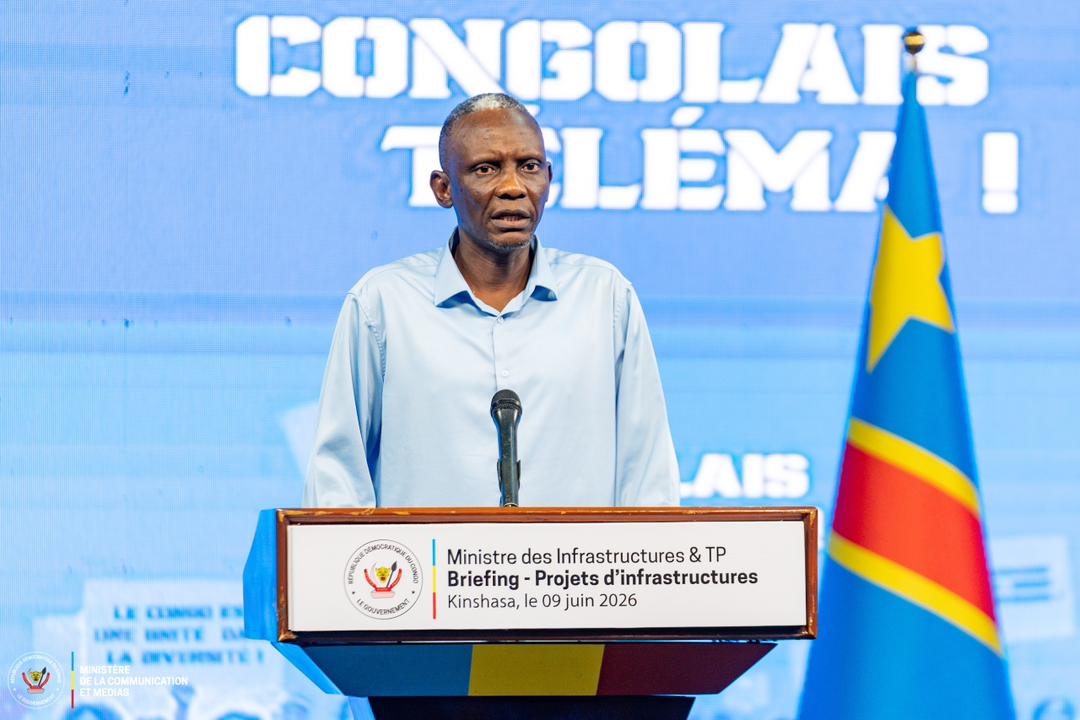
DRC: John Banza Unveils Major Infrastructure Projects Aimed at Reconnecting the Country
During a special briefing held in Kinshasa on June 9, 2026, the Minister of Infrastructure and Public Works, John Banza Lunda, presented the progress made on major road and infrastructure projects across the Democratic Republic of the Congo (DRC). Addressing the press, the government official detailed ongoing projects throughout the country while also revisiting the resolutions adopted during the first National Conference on Infrastructure, organized under the leadership of President Félix Tshisekedi.
According to the minister, the government's current policy seeks to make infrastructure a powerful tool for reducing isolation, strengthening national integration, and promoting economic development. He emphasized that the DRC must gradually rebuild its road network in order to reconnect provinces, facilitate the movement of people and goods, and stimulate trade.
Before discussing ongoing projects, John Banza highlighted the significance of the first National Conference on Infrastructure, describing it as a landmark event for the sector. The conference brought together key national stakeholders to define a shared vision for the country's infrastructure development.
Among the major resolutions adopted was the development of the country's first national technical standards for public works. The minister noted that, more than sixty years after independence, the DRC had never established a comprehensive national technical framework to regulate the construction of roads, bridges, and other infrastructure projects.
"We are going to provide the country with approximately 350 technical standards that will ensure the quality, safety, and durability of our infrastructure," he explained.
RN1: The Backbone of the National Road Network
Among the government's achievements, the minister first highlighted National Road No. 1 (RN1), considered the backbone of the Congolese road network.
Stretching nearly 3,300 kilometers, the road links the Port of Banana in Kongo Central Province to Haut-Katanga Province, crossing several regions of the country. According to John Banza, approximately 2,500 kilometers have already been built or rehabilitated under this extensive program.
The infrastructure is expected to strengthen connectivity between the country's main economic corridors and facilitate the transportation of agricultural, industrial, and mining products.
RN2 and the Country's First Modern Highway
The minister also emphasized the National Road No. 2 (RN2), which connects Mbuji-Mayi to Bukavu.
The 1,080-kilometer project crosses the provinces of Kasai Oriental, Lomami, Maniema, and South Kivu. It includes the construction of the DRC's first modern highway, designed with two lanes in each direction.
Among the major structures planned along this route is a 714-meter bridge linking Lomami and Maniema provinces. It will become the country's second-longest bridge after the former Marshal Bridge, now known as Matadi Bridge.
According to the minister, construction work has already begun on several sections.
RN4: Accelerated Progress Expected Between Kisangani and Beni
Regarding National Road No. 4 (RN4), which links Kisangani and Beni, the minister acknowledged that progress has not been as fast as expected.
To address the situation, the government has initiated a revision of the contract in order to accelerate work on this strategic corridor connecting eastern DRC with the rest of the country.
The road plays a vital role in trade between Tshopo, Ituri, and North Kivu provinces.
New Roads to Connect Isolated Provinces
The minister also presented several other strategic projects.
National Road No. 7 (RN7) is expected to connect Kananga to Kisangani through Sankuru and Tshuapa provinces. With technical studies already completed, the government plans to launch the contracting phase before construction begins.
National Road No. 6 (RN6), linking Zongo, Gemena, Lisala, Bumba, and Kisangani, also remains a government priority. Several sections have already been completed, particularly in the Uele region.
In Kongo Central Province, work is progressing on National Roads No. 12 and No. 16. These projects are expected to improve access to the territories of Tshela, Luozi, Kimvula, and Nkamba while strengthening connections with RN1.
Connecting Western DRC to Equateur Province
The government is also pursuing work on National Road No. 17 (RN17), which runs from Mongata through Bandundu City, Bagata, and Nioki, with the ultimate goal of reaching Mbandaka.
At the same time, the imminent launch of construction on National Road No. 8 (RN8) is expected to strengthen links between Equateur, Tshuapa, and Tshopo provinces.
According to John Banza, these projects form part of a broader strategy to rebuild the country's national road network.
Opening Up the Country to Drive Development
For the Minister of Infrastructure, the challenge goes far beyond simply building roads.
The government's ambition is to reconnect a vast continental-sized country that has long suffered from inadequate infrastructure and limited mobility between provinces.
"We inherited a country that lacked a sufficient road network to ensure national connectivity. Today, we are working to gradually rebuild this national framework," he stated.
Through these various projects, the government hopes to stimulate economic growth, reduce transportation costs, encourage integration of provincial markets, and improve living conditions for citizens.
For the Congolese authorities, infrastructure modernization has now become one of the key pillars of the country's economic transformation.
By Christian La Grace Liolya

.png)
Commentaires (34)
Laisser un commentaire
Marie Kalonji
3 Avril 2026 · 10h22
Enfin des réformes concrètes ! J'espère sincèrement que le gouvernement tiendra ses promesses cette fois. La question du financement reste cruciale et mérite des clarifications rapides.
Patrick Luboya
3 Avril 2026 · 11h08
La réforme fiscale est une excellente nouvelle pour les PME. En tant qu'entrepreneur à Lubumbashi, je paye actuellement 30% d'impôts ce qui freine énormément mon développement. Vivement juillet 2026 !
Ange Nkosi
3 Avril 2026 · 14h55
Je reste sceptique. On entend ces discours depuis des années. Ce qui manque, c'est la volonté politique réelle et la lutte contre la corruption. Sans ça, aucune réforme ne fonctionnera.